
Variant Calling (Part 5): Benchmarking Germline Variant Calling with nf-core/sarek
Throughout this series we have looked at how a variant calling workflow can be built, migrated and optimised. What matters at the end, however, is not how modern the tooling is but whether the calls hold up against a reference. In this post we benchmark several variant callers on the Genome in a Bottle (GIAB) HG002 sample using nf-core/sarek, and score the results with hap.py against the NIST truth set. The numbers we obtained for SNP and indel calling were consistent with those reported in the sarek publication, with recall and precision above 99% for most tools.
- The environments and scripts are uploaded to nf-germline-short-read-variant-calling.
- Clone the repository at tag 0.3.0 to reproduce the contents of this post.
Series overview
- Part 1 — a bash workflow with a reproducible Pixi environment.
- Part 2 — migrating the same steps to Nextflow and validating the result.
- Part 3 — production-scale deployment.
- Part 4 — testing and linting.
- Part 5 (this post) — benchmarking against a gold-standard truth set.
Clone the repository:
git clone git@github.com:nttg8100/nf-germline-short-read-variant-calling.git -b 0.3.0cd nf-germline-short-read-variant-callingcd benchmark/pipelines/sarek1. Preparing the dataset
Prepare input.csv as shown below. Nextflow can download the dataset automatically.
patient,sex,status,sample,lane,fastq_1,fastq_2HG002,XY,0,HG002,1,s3://human-pangenomics/NHGRI_UCSC_panel/HG002/hpp_HG002_NA24385_son_v1/ILMN/downsampled/HG002_HiSeq30x_subsampled_R1.fastq.gz,s3://human-pangenomics/NHGRI_UCSC_panel/HG002/hpp_HG002_NA24385_son_v1/ILMN/downsampled/HG002_HiSeq30x_subsampled_R2.fastq.gzThe benchmark uses the HG002 sample from the Genome in a Bottle (GIAB) consortium. HG002 is widely used as a reference dataset for benchmarking germline variant calling because it provides:
- high-confidence truth variants,
- high-confidence confident regions,
- well-curated reference datasets for SNPs and indels.
Dataset characteristics:
- Sample: HG002 (NA24385)
- Sequencing: Illumina short reads
- Coverage: ~30X
- Reference genome: GRCh38
- Truth set: GIAB high-confidence variant calls
The truth VCF and the confident-region BED file are used to compare predicted variants against the gold standard.
2. Running nf-core/sarek
We allocated more computing resources so the run would finish sooner, using the configuration customized_labels.config below.
// HPC internet is quite slow, so we increase the pull timeout for singularity containerssingularity.pullTimeout="100.h"process { cpus = { 2 * task.attempt } memory = { 4.GB * task.attempt } time = { 4.h * task.attempt }
// memory errors which should be retried. otherwise error out errorStrategy = { task.exitStatus in ((130..145) + 104) ? 'retry' : 'finish' } maxRetries = 1 maxErrors = '-1'
// Process-specific resource requirements // See https://www.nextflow.io/docs/latest/config.html#config-process-selectors withLabel:error_ignore { errorStrategy = 'ignore' } withLabel:error_retry { errorStrategy = 'retry' maxRetries = 2 } withLabel:process_single { cpus = { 3 } memory = { 6.GB * task.attempt } time = { 4.h * task.attempt } } withLabel:process_low { cpus = { 6 * task.attempt } memory = { 12.GB * task.attempt } time = { 4.h * task.attempt } } withLabel:process_medium { cpus = { 64 * task.attempt } memory = { 120.GB * task.attempt } time = { 8.h * task.attempt } } withLabel:process_high { cpus = { 64 * task.attempt } memory = { 120.GB * task.attempt } time = { 16.h * task.attempt } } withLabel:process_long { time = { 20.h * task.attempt } } withLabel:process_high_memory { memory = { 200.GB * task.attempt } }}process.executor="slurm"cd benchmark/pipelines/sarekpixi run nextflow run nf-core/sarek -r 3.7.1 -profile docker,test_full_germline \ -c customized_labels.config \ --input ./input.csv \ --outdir bwamem \ --tools "deepvariant,freebayes,strelka,manta,haplotypecaller" \ --aligner "bwa-mem" \ -resumeThe results are then copied to the corresponding folder under benchmark:
├── pipelines│ └── sarek│ ├── customized_labels.config│ ├── input.csv│ ├── pixi.lock│ ├── pixi.toml│ ├── run_pipeline.sh│ └── variant_calling│ ├── deepvariant│ │ └── HG002│ │ ├── HG002.deepvariant.g.vcf.gz│ │ ├── HG002.deepvariant.g.vcf.gz.tbi│ │ ├── HG002.deepvariant.vcf.gz│ │ └── HG002.deepvariant.vcf.gz.tbi│ ├── filtered│ │ └── HG002│ │ ├── HG002.deepvariant.bcftools_filtered.vcf.gz│ │ ├── HG002.deepvariant.bcftools_filtered.vcf.gz.tbi│ │ ├── HG002.freebayes.filtered.bcftools_filtered.vcf.gz│ │ ├── HG002.freebayes.filtered.bcftools_filtered.vcf.gz.tbi│ │ ├── HG002.haplotypecaller.filtered.bcftools_filtered.vcf.gz│ │ ├── HG002.haplotypecaller.filtered.bcftools_filtered.vcf.gz.tbi│ │ ├── HG002.strelka.variants.bcftools_filtered.vcf.gz│ │ └── HG002.strelka.variants.bcftools_filtered.vcf.gz.tbi│ ├── freebayes│ │ └── HG002│ │ ├── HG002.freebayes.filtered.vcf.gz│ │ ├── HG002.freebayes.filtered.vcf.gz.tbi│ │ ├── HG002.freebayes.vcf.gz│ │ └── HG002.freebayes.vcf.gz.tbi│ ├── haplotypecaller│ │ └── HG002│ │ ├── HG002.haplotypecaller.filtered.vcf.gz│ │ ├── HG002.haplotypecaller.filtered.vcf.gz.tbi│ │ ├── HG002.haplotypecaller.vcf.gz│ │ └── HG002.haplotypecaller.vcf.gz.tbi│ ├── manta│ │ └── HG002│ │ ├── HG002.manta.diploid_sv.vcf.gz│ │ └── HG002.manta.diploid_sv.vcf.gz.tbi│ └── strelka│ └── HG002│ ├── HG002.strelka.genome.vcf.gz│ ├── HG002.strelka.genome.vcf.gz.tbi│ ├── HG002.strelka.variants.vcf.gz│ └── HG002.strelka.variants.vcf.gz.tbi3. Benchmarking with the HG002 dataset
3.1 Downloading the truth set and reference data
As a proof of concept, this benchmark uses a single sample. Many more samples from GIAB and other public truth datasets can be used; the download.sh script in the references folder can be extended accordingly.
# download GATK reference genomeaws s3 cp --recursive --no-sign-request s3://ngi-igenomes/igenomes/Homo_sapiens/GATK/GRCh38/Sequence/WholeGenomeFasta/ .
# download reference files for benchmarkingwget https://ftp-trace.ncbi.nlm.nih.gov/ReferenceSamples/giab/release/AshkenazimTrio/HG002_NA24385_son/NISTv4.2.1/GRCh38/HG002_GRCh38_1_22_v4.2.1_benchmark.vcf.gzwget https://ftp-trace.ncbi.nlm.nih.gov/ReferenceSamples/giab/release/AshkenazimTrio/HG002_NA24385_son/NISTv4.2.1/GRCh38/HG002_GRCh38_1_22_v4.2.1_benchmark.vcf.gz.tbi# download bed files for confident regionswget https://ftp-trace.ncbi.nlm.nih.gov/ReferenceSamples/giab/release/AshkenazimTrio/HG002_NA24385_son/NISTv4.2.1/GRCh38/HG002_GRCh38_1_22_v4.2.1_benchmark_noinconsistent.bedDownload the data by running:
cd benchmark/referencespixi run download.shThe downloaded files are laid out as follows:
benchmark/├── Readme.md├── benchmark.sh├── benchmark_rewrite.sh├── pipelines│ └── sarek│ ├── customized_labels.config│ ├── input.csv│ ├── pixi.lock│ ├── pixi.toml│ ├── run_pipeline.sh│ └── variant_calling│ ├── deepvariant│ │ └── HG002│ │ ├── HG002.deepvariant.g.vcf.gz│ │ ├── HG002.deepvariant.g.vcf.gz.tbi│ │ ├── HG002.deepvariant.vcf.gz│ │ └── HG002.deepvariant.vcf.gz.tbi│ ├── filtered│ │ └── HG002│ │ ├── HG002.deepvariant.bcftools_filtered.vcf.gz│ │ ├── HG002.deepvariant.bcftools_filtered.vcf.gz.tbi│ │ ├── HG002.freebayes.filtered.bcftools_filtered.vcf.gz│ │ ├── HG002.freebayes.filtered.bcftools_filtered.vcf.gz.tbi│ │ ├── HG002.haplotypecaller.filtered.bcftools_filtered.vcf.gz│ │ ├── HG002.haplotypecaller.filtered.bcftools_filtered.vcf.gz.tbi│ │ ├── HG002.strelka.variants.bcftools_filtered.vcf.gz│ │ └── HG002.strelka.variants.bcftools_filtered.vcf.gz.tbi│ ├── freebayes│ │ └── HG002│ │ ├── HG002.freebayes.filtered.vcf.gz│ │ ├── HG002.freebayes.filtered.vcf.gz.tbi│ │ ├── HG002.freebayes.vcf.gz│ │ └── HG002.freebayes.vcf.gz.tbi│ ├── haplotypecaller│ │ └── HG002│ │ ├── HG002.haplotypecaller.filtered.vcf.gz│ │ ├── HG002.haplotypecaller.filtered.vcf.gz.tbi│ │ ├── HG002.haplotypecaller.vcf.gz│ │ └── HG002.haplotypecaller.vcf.gz.tbi│ ├── manta│ │ └── HG002│ │ ├── HG002.manta.diploid_sv.vcf.gz│ │ └── HG002.manta.diploid_sv.vcf.gz.tbi│ └── strelka│ └── HG002│ ├── HG002.strelka.genome.vcf.gz│ ├── HG002.strelka.genome.vcf.gz.tbi│ ├── HG002.strelka.variants.vcf.gz│ └── HG002.strelka.variants.vcf.gz.tbi├── pixi.lock├── pixi.toml├── references│ ├── HG002_GRCh38_1_22_v4.2.1_benchmark.vcf.gz│ ├── HG002_GRCh38_1_22_v4.2.1_benchmark.vcf.gz.tbi│ ├── HG002_GRCh38_1_22_v4.2.1_benchmark_noinconsistent.bed│ ├── Homo_sapiens_assembly38.dict│ ├── Homo_sapiens_assembly38.fasta│ ├── Homo_sapiens_assembly38.fasta.fai│ ├── download.sh│ ├── pixi.lock│ └── pixi.toml3.2 The benchmarking tool
Here we use hap.py to benchmark germline SNP and indel calls. The original publication is available at https://www.nature.com/articles/s41587-019-0054-x.
What it does:
- It reformats variant records to find matches between the query and the truth set in the VCF.
- Two variants that are identical in effect may be written with different positions or alternative nucleotides; the example below shows such a pair.
- After reformatting the records,
hap.pycomputes metrics that describe how well each caller performed.
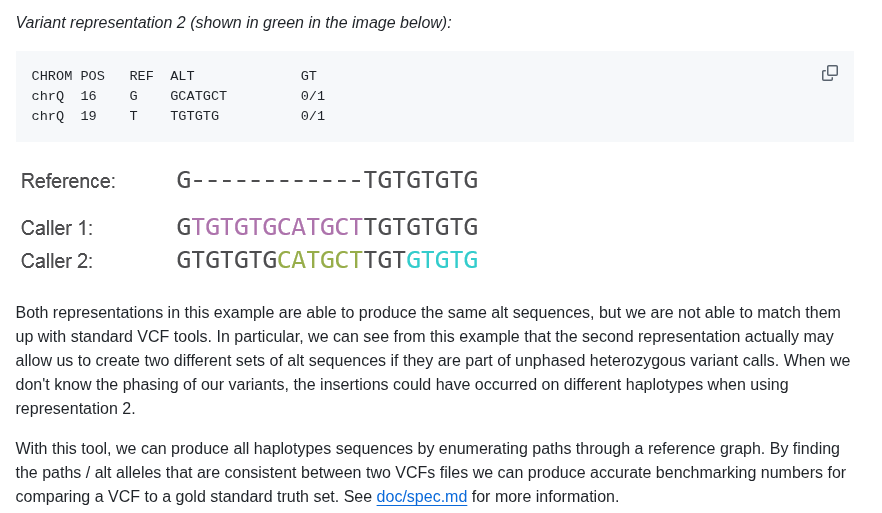
Example output table:
| Type | Filter | TRUTH.TOTAL | TRUTH.TP | TRUTH.FN | QUERY.TOTAL | QUERY.FP | QUERY.UNK | FP.gt | FP.al | METRIC.Recall | METRIC.Precision | METRIC.Frac_NA | METRIC.F1_Score | TRUTH.TOTAL.TiTv_ratio | QUERY.TOTAL.TiTv_ratio | TRUTH.TOTAL.het_hom_ratio | QUERY.TOTAL.het_hom_ratio |
|---|---|---|---|---|---|---|---|---|---|---|---|---|---|---|---|---|---|
| INDEL | ALL | 525469 | 520048 | 5421 | 908475 | 2949 | 363798 | 2010 | 455 | 0.989684 | 0.9945860000000001 | 0.400449 | 0.992129 | 1.528275734138537 | 1.9313187724266925 | ||
| INDEL | PASS | 525469 | 520048 | 5421 | 908475 | 2949 | 363798 | 2010 | 455 | 0.989684 | 0.9945860000000001 | 0.400449 | 0.992129 | 1.528275734138537 | 1.9313187724266925 | ||
| SNP | ALL | 3365127 | 3344549 | 20578 | 3841759 | 5292 | 490176 | 1401 | 562 | 0.993885 | 0.9984209999999999 | 0.127592 | 0.9961479999999999 | 2.1001284867575745 | 1.9839843850083037 | 1.5811958532541182 | 1.4858796715961773 |
| SNP | PASS | 3365127 | 3344549 | 20578 | 3841759 | 5292 | 490176 | 1401 | 562 | 0.993885 | 0.9984209999999999 | 0.127592 | 0.9961479999999999 | 2.1001284867575745 | 1.9839843850083037 | 1.5811958532541182 | 1.4858796715961773 |
The columns produced by hap.py are explained in its documentation, as summarised below.
hap.py outputs a set of stratification columns followed by metrics columns. Stratification columns may contain the placeholder *, which indicates that the counts in that row are aggregated over all possible values of the column. For a subtype, this means the counts have been summed across all subtypes; for QQ, it means the counts correspond to all variants rather than only those below a QQ threshold.
| Stratification Column | Description |
|---|---|
| Type | Variant type (SNP / INDEL) |
| Subtype | Variant Subtype (ti/tv/indel length, see above) |
| Subset | Subset of the genome/stratification region |
| Filter | Variant filters: PASS, SEL, ALL, or a particular filter from the query VCF |
| Genotype | Genotype of benchmarked variants (het / homalt / hetalt) |
| QQ.Field | Which field from the original VCF was used to produce QQ values in truth and query |
| QQ threshold for ROC values |
| Metric Column | Description |
|---|---|
| METRIC.Recall | Recall for truth variant representation = TRUTH.TP / (TRUTH.TP + TRUTH.FN) |
| METRIC.Precision | Precision of query variants = QUERY.TP / (QUERY.TP + QUERY.FP) |
| METRIC.Frac_NA | Fraction of non-assessed query calls = QUERY.UNK / QUERY.TOTAL |
| METRIC.F1_Score | Harmonic mean of precision and recall = 2METRIC.RecallMetric.Precision/(METRIC.Recall + METRIC.Precision) |
| TRUTH.TOTAL | Total number of truth variants |
| TRUTH.TP | Number of true-positive calls in truth representation (counted via the truth sample column) |
| TRUTH.FN | Number of false-negative calls = calls in truth without matching query call |
| QUERY.TOTAL | Total number of query calls |
| QUERY.TP | Number of true positive calls in query representation (counted via the query sample column) |
| QUERY.FP | Number of false-positive calls in the query file (mismatched query calls within the confident regions) |
| QUERY.UNK | Number of query calls outside the confident regions |
| FP.gt | Number of genotype mismatches (alleles match, but different zygosity) |
| FP.al | Number of allele mismatches (variants matched by position and not by haplotype) |
| TRUTH.TOTAL.TiTv_ratio | Transition / Transversion ratio for all truth variants |
| TRUTH.TOTAL.het_hom_ratio | Het/Hom ratio for all truth variants |
| TRUTH.FN.TiTv_ratio | Transition / Transversion ratio for false-negative variants |
| TRUTH.FN.het_hom_ratio | Het/Hom ratio for false-negative variants |
| TRUTH.TP.TiTv_ratio | Transition / Transversion ratio for true positive variants |
| TRUTH.TP.het_hom_ratio | Het/Hom ratio for true positive variants |
| QUERY.FP.TiTv_ratio | Transition / Transversion ratio for false positive variants |
| QUERY.FP.het_hom_ratio | Het/Hom ratio for false-positive variants |
| QUERY.TOTAL.TiTv_ratio | Transition / Transversion ratio for all query variants |
| QUERY.TOTAL.het_hom_ratio | Het/Hom ratio for all query variants |
| QUERY.TP.TiTv_ratio | Transition / Transversion ratio for true positive variants (query representation) |
| QUERY.TP.het_hom_ratio | Het/Hom ratio for true positive variants (query representation) |
| QUERY.UNK.TiTv_ratio | Transition / Transversion ratio for unknown variants |
| QUERY.UNK.het_hom_ratio | Het/Hom ratio for unknown variants |
| Subset.Size | When using stratification regions, this gives the number of nucleotides contained in the current subset |
| Subset.IS_CONF.Size | This gives the number of confident bases (-f regions) in the current subset |
3.3 Benchmark script and environment
3.3.1 Installation and script
#!/bin/bash# Benchmark script for HG002 with DeepVariant, FreeBayes, HaplotypeCaller, Manta, Strelka (relative paths)set -euo pipefail
HGREF="references/Homo_sapiens_assembly38.fasta"REF="HG002"BED="references/${REF}_GRCh38_1_22_v4.2.1_benchmark_noinconsistent.bed"TRUTH="references/${REF}_GRCh38_1_22_v4.2.1_benchmark.vcf.gz"SDF="references/grch38.sdf"THREADS=16
RESULTSDIR="results"mkdir -p "$RESULTSDIR"
TOOLS=(deepvariant freebayes haplotypecaller manta strelka)
VCF_DEEPVARIANT="pipelines/sarek/variant_calling/deepvariant/HG002/HG002.deepvariant.vcf.gz"VCF_FREEBAYES="pipelines/sarek/variant_calling/freebayes/HG002/HG002.freebayes.vcf.gz"VCF_HAPLOTYPECALLER="pipelines/sarek/variant_calling/haplotypecaller/HG002/HG002.haplotypecaller.vcf.gz"VCF_MANTA="pipelines/sarek/variant_calling/manta/HG002/HG002.manta.diploid_sv.vcf.gz"VCF_STRELKA="pipelines/sarek/variant_calling/strelka/HG002/HG002.strelka.variants.vcf.gz"
# Path mapdeclare -A VCF_PATHS=( [deepvariant]="$VCF_DEEPVARIANT" [freebayes]="$VCF_FREEBAYES" [haplotypecaller]="$VCF_HAPLOTYPECALLER" [manta]="$VCF_MANTA" [strelka]="$VCF_STRELKA")
for TOOL in "${TOOLS[@]}"; do TOOLDIR="$RESULTSDIR/$TOOL" mkdir -p "$TOOLDIR" VCF="${VCF_PATHS[$TOOL]}" LOG="$TOOLDIR/${REF}_${TOOL}.log" SUMMARY="$TOOLDIR/${REF}_${TOOL}.summary.csv" FORMATTED="$TOOLDIR/${REF}_${TOOL}.formatted.summary.csv" OUTPUT="$TOOLDIR/${REF}_${TOOL}"
# If the tool output folder already exists with summary file, continue from AWK formatting (line 55) if [[ -f "${OUTPUT}.summary.csv" ]]; then echo "Output for $TOOL already exists, formatting summary." awk -v d="${TOOL}_${REF}" -F',' 'FNR==1{a="run"} FNR>1{a=d} {print $0",\t"a}' "${OUTPUT}.summary.csv" > "$FORMATTED" echo "Completed $TOOL (using existing output)" continue fi
if [[ ! -f "$VCF" ]]; then echo "VCF file not found for $TOOL: $VCF" >&2 continue fi
echo "Benchmarking $TOOL for $REF ..." hap.py "$TRUTH" "$VCF" \ -o "$OUTPUT" \ -V --engine=vcfeval --threads "$THREADS" --engine-vcfeval-template "$SDF" \ -f "$BED" \ --logfile "$LOG" \ --scratch-prefix .
if [[ -f "${OUTPUT}.summary.csv" ]]; then awk -v d="${TOOL}_${REF}" -F',' 'FNR==1{a="run"} FNR>1{a=d} {print $0",\t"a}' "${OUTPUT}.summary.csv" > "$FORMATTED" else echo "Warning: ${OUTPUT}.summary.csv not found for $TOOL" >&2 fi
echo "Completed $TOOL"done
MERGED="$RESULTSDIR/merged_${REF}_benchmark.csv"echo "Merging summaries to $MERGED ..."awk '(NR == 1) || (FNR > 1)' "$RESULTSDIR"/*/*.formatted.summary.csv > "$MERGED"echo "All done. Results for $REF in $MERGED"3.3.2 Running the benchmark
Running the script produces output laid out as follows:
├── results│ └── sarek│ ├── deepvariant│ │ ├── HG002_deepvariant.extended.csv│ │ ├── HG002_deepvariant.formatted.summary.csv│ │ ├── HG002_deepvariant.log│ │ ├── HG002_deepvariant.metrics.json.gz│ │ ├── HG002_deepvariant.roc.Locations.INDEL.PASS.csv.gz│ │ ├── HG002_deepvariant.roc.Locations.INDEL.csv.gz│ │ ├── HG002_deepvariant.roc.Locations.SNP.PASS.csv.gz│ │ ├── HG002_deepvariant.roc.Locations.SNP.csv.gz│ │ ├── HG002_deepvariant.roc.all.csv.gz│ │ ├── HG002_deepvariant.runinfo.json│ │ ├── HG002_deepvariant.summary.csv│ │ ├── HG002_deepvariant.vcf.gz│ │ └── HG002_deepvariant.vcf.gz.tbi│ ├── freebayes│ │ ├── HG002_freebayes.extended.csv│ │ ├── HG002_freebayes.formatted.summary.csv│ │ ├── HG002_freebayes.log│ │ ├── HG002_freebayes.metrics.json.gz│ │ ├── HG002_freebayes.roc.Locations.INDEL.PASS.csv.gz│ │ ├── HG002_freebayes.roc.Locations.INDEL.csv.gz│ │ ├── HG002_freebayes.roc.Locations.SNP.PASS.csv.gz│ │ ├── HG002_freebayes.roc.Locations.SNP.csv.gz│ │ ├── HG002_freebayes.roc.all.csv.gz│ │ ├── HG002_freebayes.runinfo.json│ │ ├── HG002_freebayes.summary.csv│ │ ├── HG002_freebayes.vcf.gz│ │ └── HG002_freebayes.vcf.gz.tbi│ ├── haplotypecaller│ │ ├── HG002_haplotypecaller.extended.csv│ │ ├── HG002_haplotypecaller.formatted.summary.csv│ │ ├── HG002_haplotypecaller.log│ │ ├── HG002_haplotypecaller.metrics.json.gz│ │ ├── HG002_haplotypecaller.roc.Locations.INDEL.PASS.csv.gz│ │ ├── HG002_haplotypecaller.roc.Locations.INDEL.csv.gz│ │ ├── HG002_haplotypecaller.roc.Locations.SNP.PASS.csv.gz│ │ ├── HG002_haplotypecaller.roc.Locations.SNP.csv.gz│ │ ├── HG002_haplotypecaller.roc.all.csv.gz│ │ ├── HG002_haplotypecaller.runinfo.json│ │ ├── HG002_haplotypecaller.summary.csv│ │ ├── HG002_haplotypecaller.vcf.gz│ │ └── HG002_haplotypecaller.vcf.gz.tbi│ ├── manta│ │ ├── HG002_manta.extended.csv│ │ ├── HG002_manta.formatted.summary.csv│ │ ├── HG002_manta.log│ │ ├── HG002_manta.metrics.json.gz│ │ ├── HG002_manta.roc.Locations.INDEL.PASS.csv.gz│ │ ├── HG002_manta.roc.Locations.INDEL.csv.gz│ │ ├── HG002_manta.roc.Locations.SNP.PASS.csv.gz│ │ ├── HG002_manta.roc.Locations.SNP.csv.gz│ │ ├── HG002_manta.roc.all.csv.gz│ │ ├── HG002_manta.runinfo.json│ │ ├── HG002_manta.summary.csv│ │ ├── HG002_manta.vcf.gz│ │ └── HG002_manta.vcf.gz.tbi│ ├── merged_HG002_benchmark.csv│ └── strelka│ ├── HG002_strelka.extended.csv│ ├── HG002_strelka.formatted.summary.csv│ ├── HG002_strelka.log│ ├── HG002_strelka.metrics.json.gz│ ├── HG002_strelka.roc.Locations.INDEL.PASS.csv.gz│ ├── HG002_strelka.roc.Locations.INDEL.csv.gz│ ├── HG002_strelka.roc.Locations.SNP.PASS.csv.gz│ ├── HG002_strelka.roc.Locations.SNP.csv.gz│ ├── HG002_strelka.roc.all.csv.gz│ ├── HG002_strelka.runinfo.json│ ├── HG002_strelka.summary.csv│ ├── HG002_strelka.vcf.gz│ └── HG002_strelka.vcf.gz.tbi3.3.3 Reading the results
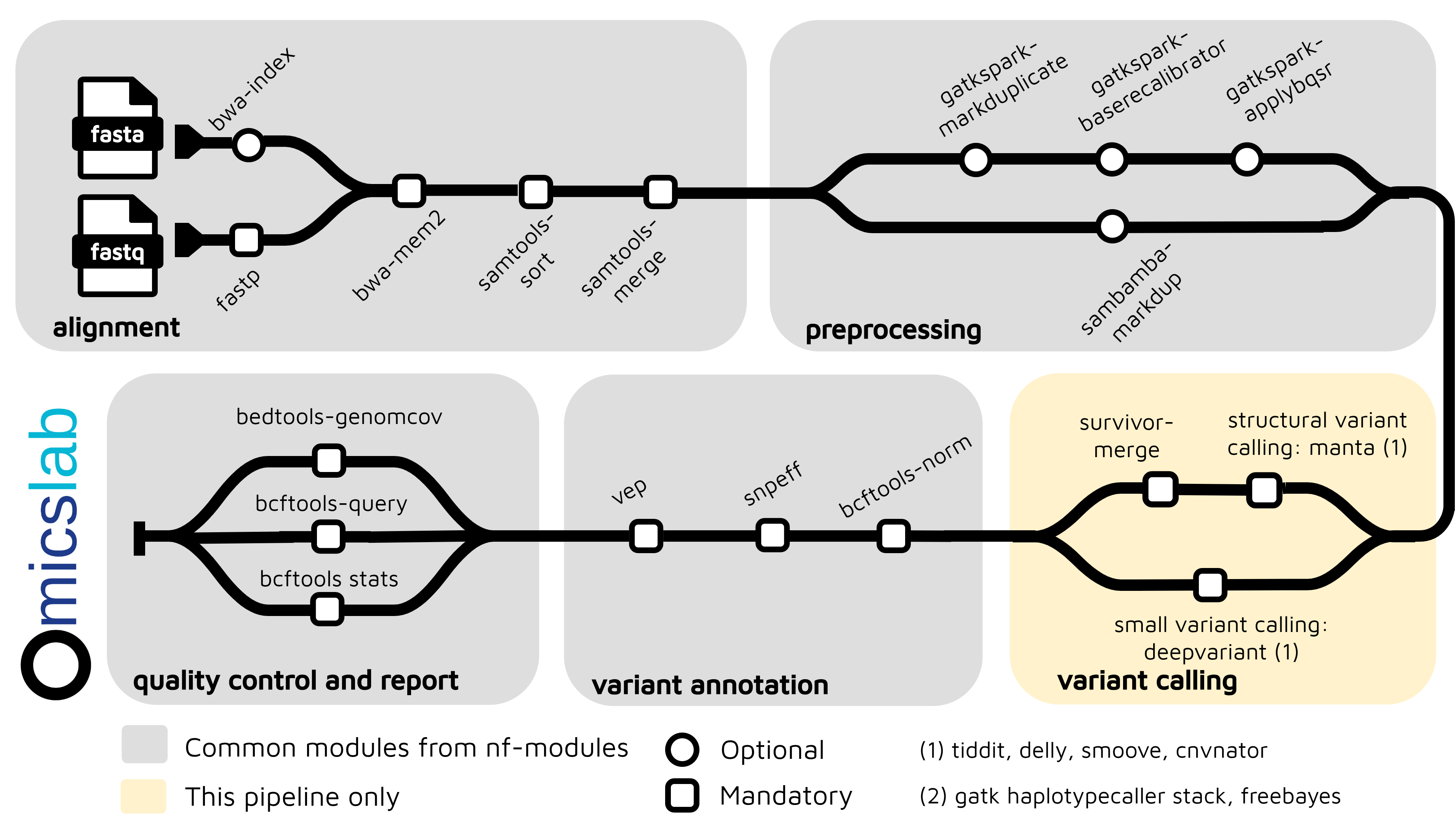
We benchmarked several widely used variant callers — DeepVariant, FreeBayes, HaplotypeCaller, Strelka and Manta — on the HG002 dataset, evaluating SNPs and indels separately with recall, precision and F1 score.
In these runs, DeepVariant showed the most balanced performance, with the highest combination of recall and precision for both SNPs (F1 ≈ 0.996) and indels (F1 ≈ 0.992). HaplotypeCaller and Strelka also performed well, with slightly lower recall or precision depending on the variant type. FreeBayes reached comparable recall but noticeably lower precision, indicating more false positives.
SNP detection was consistently strong across most tools (recall ≈ 0.99), while indel calling showed more variability, which is consistent with the greater difficulty of detecting small insertions and deletions accurately.
As expected, Manta performed poorly on SNPs and indels, because it is designed for structural variant detection rather than small variants.
Overall, these results suggest that machine-learning-based callers such as DeepVariant provide the most balanced performance, while traditional callers remain competitive but may need stricter filtering to control false positives.
- These observations are consistent with the results reported for an older version of sarek, published in June 2024: https://academic.oup.com/nargab/article/doi/10.1093/nargab/lqae031/7658070
The aggregated results in merged_HG002_benchmark.csv are shown below.
| Type | Filter | TRUTH.TOTAL | TRUTH.TP | TRUTH.FN | QUERY.TOTAL | QUERY.FP | QUERY.UNK | FP.gt | FP.al | METRIC.Recall | METRIC.Precision | METRIC.Frac_NA | METRIC.F1_Score | TRUTH.TOTAL.TiTv_ratio | QUERY.TOTAL.TiTv_ratio | TRUTH.TOTAL.het_hom_ratio | QUERY.TOTAL.het_hom_ratio | run |
|---|---|---|---|---|---|---|---|---|---|---|---|---|---|---|---|---|---|---|
| INDEL | ALL | 525469 | 520048 | 5421 | 908475 | 2949 | 363798 | 2010 | 455 | 0.989684 | 0.994586 | 0.400449 | 0.992129 | 1.528275734138537 | 1.9313187724266925 | deepvariant_HG002 | ||
| INDEL | PASS | 525469 | 520048 | 5421 | 908475 | 2949 | 363798 | 2010 | 455 | 0.989684 | 0.994586 | 0.400449 | 0.992129 | 1.528275734138537 | 1.9313187724266925 | deepvariant_HG002 | ||
| SNP | ALL | 3365127 | 3344549 | 20578 | 3841759 | 5292 | 490176 | 1401 | 562 | 0.993885 | 0.998421 | 0.127592 | 0.996148 | 2.1001284867575745 | 1.9839843850083037 | 1.5811958532541182 | 1.4858796715961773 | deepvariant_HG002 |
| SNP | PASS | 3365127 | 3344549 | 20578 | 3841759 | 5292 | 490176 | 1401 | 562 | 0.993885 | 0.998421 | 0.127592 | 0.996148 | 2.1001284867575745 | 1.9839843850083037 | 1.5811958532541182 | 1.4858796715961773 | deepvariant_HG002 |
| INDEL | ALL | 525469 | 504432 | 21037 | 881738 | 19441 | 341005 | 13873 | 1528 | 0.959965 | 0.964047 | 0.386742 | 0.962002 | 1.528275734138537 | 1.8211051374734122 | freebayes_HG002 | ||
| INDEL | PASS | 525469 | 504432 | 21037 | 881738 | 19441 | 341005 | 13873 | 1528 | 0.959965 | 0.964047 | 0.386742 | 0.962002 | 1.528275734138537 | 1.8211051374734122 | freebayes_HG002 | ||
| SNP | ALL | 3365127 | 3344473 | 20654 | 4423242 | 129028 | 946030 | 3762 | 16431 | 0.993862 | 0.962893 | 0.213877 | 0.978133 | 2.1001284867575745 | 1.8132303933942775 | 1.5811958532541182 | 1.8836484571228804 | freebayes_HG002 |
| SNP | PASS | 3365127 | 3344473 | 20654 | 4423242 | 129028 | 946030 | 3762 | 16431 | 0.993862 | 0.962893 | 0.213877 | 0.978133 | 2.1001284867575745 | 1.8132303933942775 | 1.5811958532541182 | 1.8836484571228804 | freebayes_HG002 |
| INDEL | ALL | 525469 | 516926 | 8543 | 895219 | 6343 | 351037 | 3797 | 436 | 0.983742 | 0.988344 | 0.392124 | 0.986038 | 1.528275734138537 | 1.8797119780755498 | haplotypecaller_HG002 | ||
| INDEL | PASS | 525469 | 516926 | 8543 | 895219 | 6343 | 351037 | 3797 | 436 | 0.983742 | 0.988344 | 0.392124 | 0.986038 | 1.528275734138537 | 1.8797119780755498 | haplotypecaller_HG002 | ||
| SNP | ALL | 3365127 | 3340110 | 25017 | 3957190 | 28452 | 587714 | 2758 | 2288 | 0.992566 | 0.991556 | 0.148518 | 0.992061 | 2.1001284867575745 | 1.9560158340309197 | 1.5811958532541182 | 1.7246457081290798 | haplotypecaller_HG002 |
| SNP | PASS | 3365127 | 3340110 | 25017 | 3957190 | 28452 | 587714 | 2758 | 2288 | 0.992566 | 0.991556 | 0.148518 | 0.992061 | 2.1001284867575745 | 1.9560158340309197 | 1.5811958532541182 | 1.7246457081290798 | haplotypecaller_HG002 |
| INDEL | ALL | 525469 | 8 | 525461 | 7821 | 114 | 7699 | 0 | 42 | 1.5e-05 | 0.065574 | 0.984401 | 3e-05 | 1.528275734138537 | 1.0282749675745784 | manta_HG002 | ||
| INDEL | PASS | 525469 | 8 | 525461 | 6877 | 106 | 6763 | 0 | 36 | 1.5e-05 | 0.070175 | 0.983423 | 3e-05 | 1.528275734138537 | 1.060851318944844 | manta_HG002 | ||
| SNP | ALL | 3365127 | 3 | 3365124 | 1416 | 4 | 1408 | 0 | 0 | 1e-06 | 0.5 | 0.99435 | 2e-06 | 2.1001284867575745 | 0.9005524861878453 | 1.5811958532541182 | 1.002828854314003 | manta_HG002 |
| SNP | PASS | 3365127 | 3 | 3365124 | 1230 | 4 | 1222 | 0 | 0 | 1e-06 | 0.5 | 0.993496 | 2e-06 | 2.1001284867575745 | 0.8307692307692308 | 1.5811958532541182 | 0.9967532467532467 | manta_HG002 |
| INDEL | ALL | 525469 | 515560 | 9909 | 875380 | 6569 | 334974 | 4149 | 572 | 0.981143 | 0.987844 | 0.382661 | 0.984482 | 1.528275734138537 | 1.8953993716115898 | strelka_HG002 | ||
| INDEL | PASS | 525469 | 513675 | 11794 | 834212 | 3403 | 298722 | 2401 | 324 | 0.977555 | 0.993645 | 0.358089 | 0.985535 | 1.528275734138537 | 1.8205751890885689 | strelka_HG002 | ||
| SNP | ALL | 3365127 | 3341546 | 23581 | 4233605 | 67357 | 821358 | 4302 | 7749 | 0.992993 | 0.98026 | 0.194009 | 0.986585 | 2.1001284867575745 | 1.8583435698762165 | 1.5811958532541182 | 1.8781977072413574 | strelka_HG002 |
| SNP | PASS | 3365127 | 3323449 | 41678 | 3676907 | 4389 | 345864 | 909 | 758 | 0.987615 | 0.998682 | 0.094064 | 0.993118 | 2.1001284867575745 | 2.038753419553027 | 1.5811958532541182 | 1.57305061157284 | strelka_HG002 |
4. Recap
- Using a modern framework helps, but what matters more is how much accuracy and reliability the pipeline demonstrates.
- A pipeline should be reviewed and benchmarked against its own gold standard as it is developed.
- Adding steps does not necessarily improve results, and may increase computing cost; that is the subject of a future post.
References
- hap.py — the tool used here for benchmarking germline short-read variants: https://github.com/Illumina/hap.py
- Genome in a Bottle (GIAB) — gold-standard reference datasets from NIST: https://www.nist.gov/programs-projects/genome-bottle
- nf-core/sarek publication — the reference implementation and its reported accuracy: https://academic.oup.com/nargab/article/doi/10.1093/nargab/lqae031/7658070
- GIAB HG002 benchmark files (NISTv4.2.1, GRCh38): https://ftp-trace.ncbi.nlm.nih.gov/ReferenceSamples/giab/release/AshkenazimTrio/HG002_NA24385_son/NISTv4.2.1/GRCh38/
- nf-germline-short-read-variant-calling — the repository used in this post: https://github.com/nttg8100/nf-germline-short-read-variant-calling
- Cover image: Laboratory reactives for Sanger sequencing — LuisCG11, Wikimedia Commons, CC BY-SA 4.0
Related articles
Browse all articles →